



Decathlon Introduces Circular Logistics Model to Cut Emissions and Waste
LILLE – July 2, 2025
The French sporting goods retailer Decathlon has officially launched a new circular logistics program aimed at transforming how products move through its supply chain — and how they return.
Unveiled Tuesday at its regional logistics headquarters in Lille, the program is designed to reduce carbon emissions, minimize waste, and recover materials through a fully integrated system of collection, reuse, and short-distance redistribution.
“This isn’t just about lowering our carbon footprint,” explained Thierry Leblanc, the company’s Head of Supply Chain Innovation. “It’s about building a system that treats every product and every package as a resource — even after it leaves our stores.”
Reversing the Flow: How It Operates
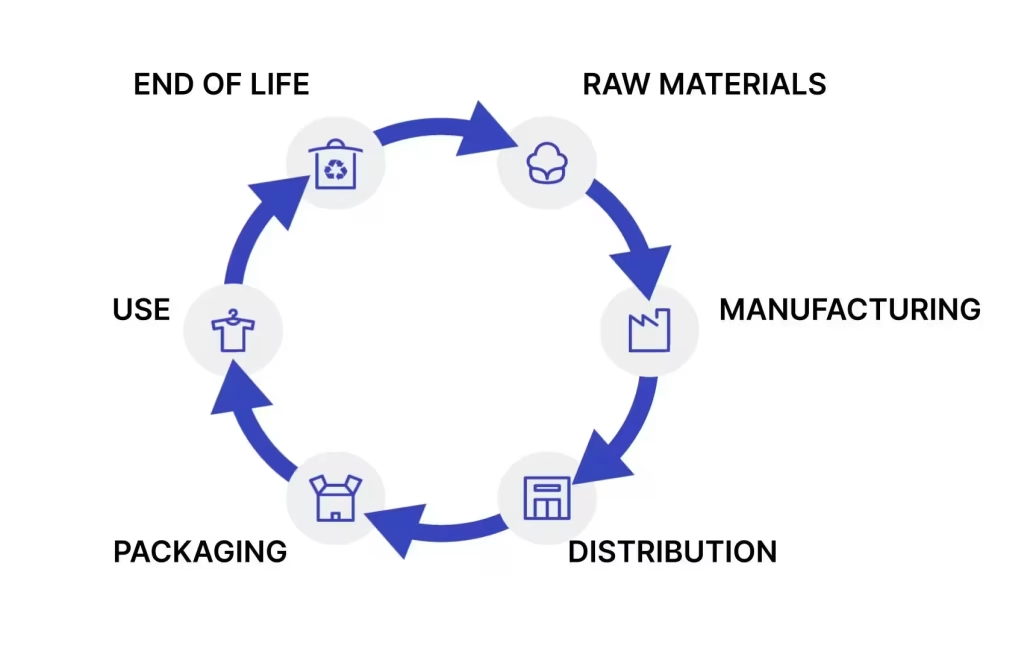
At the heart of this shift is a reverse logistics network that collects used packaging and returned merchandise from Decathlon stores and customers. These are sent back to urban hubs, where materials are sorted, cleaned, and repackaged for reuse.
Three cities — Lille, Lyon, and Brussels — currently host these hubs. Each site operates with solar-powered infrastructure, and deliveries between hubs and major warehouses are made by rail, in partnership with SNCF Fret.
In trial runs earlier this year, Decathlon recorded a 43% drop in carbon emissions per parcel, without increasing delivery times. The results, according to the company, show that sustainability can be scaled without sacrificing efficiency.
A Focus on Materials, Not Just CO₂
The project, named CycloChain, does more than cut emissions. It’s also targeting material waste. Over 1.4 million cardboard packages and 600 tons of plastic have already been recovered and reintroduced into the system since March.
Customers returning goods are offered incentives: store credits for worn equipment, or discounts when opting for reused packaging. Decathlon reports that one in ten customers is now choosing second-hand gear over new — a shift the company wants to encourage.
“We’re seeing clear signals that consumers value transparency and reuse. If logistics can support that behavior, it becomes a long-term advantage,” added Leblanc.
Sector Reactions and Next Steps
Industry experts are paying close attention. EchoTrack, a European monitoring group for sustainable logistics, has labeled CycloChain “a benchmark project” for closed-loop supply systems in the non-food retail sector.
Retailers across Europe, including Leroy Merlin and Decathlon’s direct competitor Intersport, are reportedly exploring similar models after visiting the pilot sites.
The company plans to publish its first full-cycle impact report this autumn and has pledged to share its packaging reuse standards with other companies — a rare move in a sector still tightly guarded over logistics operations.
The post Decathlon Introduces Circular Logistics Model to Cut Emissions and Waste appeared first on The Logistic News.
Share this post

Related
Posts
HMM triggers an early retirement plan: an indicator of caution in the face of weakening rates
Container shipping continues to send cooling signals. The South Korean carrier HMM is offering an early departure scheme, particularly targeting...

E-commerce China–Europe: new taxes and national fees, the air cargo market is already starting to adjust
Air cargo related to e-commerce between China and Europe is entering a phase of adjustment. In the background: the introduction...

A cargo inspected and then released: Estonia lifts suspicion of smuggling after inspection
Estonian authorities have allowed a detained cargo ship to resume its voyage after inspection, as the investigation did not confirm...

Airfreight: Demand strengthens before Chinese New Year, driven by early shipments
The beginning of 2026 shows a more dynamic airfreight than expected. After the post-holiday slowdown, volumes are picking up again,...