



Margins Under Pressure: Freight Forwarders Rethink Growth After a Brutal Q1

By Maria Kalamatas | May 16, 2025
Hamburg —
Growth is no longer the default setting.
After years of aggressive expansion, logistics providers—especially mid-sized freight forwarders—are facing a sobering reality in 2025. The first quarter has been defined not by volume or market share, but by profitability erosion, shifting customer demands, and cautious restructuring.
“We’re not scaling back,” said a managing director at a family-owned forwarding group in northern Germany. “But we’re scaling differently now. The playbook has changed.”
That shift is visible in the numbers. According to data from regional freight associations, nearly 38% of independent forwarders in Europe reported lower margins in Q1 compared to the same period in 2024—despite stable volume. The reasons? Declining contract rates. Rising last-mile costs. And a sharp increase in customer churn, as shippers shop for price over loyalty.
The dynamics are being felt hardest in general cargo and SME accounts—segments that had bounced back post-COVID but are now losing ground to platform-based aggregators and digital brokers offering instant quotes and AI-optimized pricing.
In response, forwarders are adapting—but carefully.
Some are exiting unprofitable lanes. Others are turning fixed contracts into hybrid models with volume-based triggers. A few are shifting resources toward vertical specialization—like pharma, perishables, or aerospace—where reliability still commands a premium.
Back-office costs are under review. So are long-standing partnerships. Freight alliances once built on handshake trust are being re-evaluated through new KPIs: lead-time accuracy, customer retention, margin resilience.
“We’ve gone from growth mode to protection mode,” said the CFO of a mid-market firm in Antwerp. “Now it’s about staying sharp, not just staying big.”
The technology conversation is also maturing. Instead of overhauling entire stacks, forwarders are seeking targeted gains: better visibility tools, API integrations for quoting, and automated credit scoring for clients. It’s less about digital transformation—and more about practical survival.
Industry watchers predict that by Q4, we’ll see more consolidation—quiet deals between regional players seeking operational synergies without large M&A fanfare. The big names won’t disappear. But it’s the middle that will shape the next chapter: who adapts, who resists, and who redefines what it means to grow in a slow market.
The post Margins Under Pressure: Freight Forwarders Rethink Growth After a Brutal Q1 appeared first on The Logistic News.
Share this post

Related
Posts

European Cargo to launch China–Teesside freighter services
European Cargo has announced plans to launch five weekly freighter services between China and Teesside International Airport while establishing a...
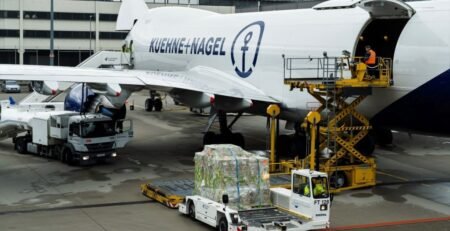
Kuehne+Nagel retains top airfreight ranking despite DSV–Schenker deal
Kuehne+Nagel (K+N) has maintained its position as the world’s largest airfreight forwarder by volume, despite DSV’s acquisition of DB Schenker...

Air cargo tackles backlogs as Middle East capacity crunch deepens
Air cargo operators continue to grapple with the fallout from escalating Middle East conflict, as airspace closures, route suspensions and...

Global energy crisis looms as Arabian Gulf exports halt
Qatar has halted LNG production at Ras Laffan, one of the world’s largest liquefied natural gas production and export terminals,...